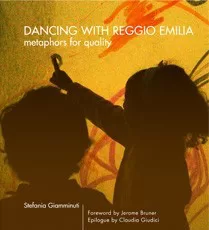
P/B • 220mm x 230mm – FULL COLOUR • 368 Pages ISBN 9781876138400 Stefania Giamminuti spent six months researching in the municipal infant–toddler centres and schools of Reggio Emilia, Italy. Her unique experiences are vividly recounted in this rich book, with its seductive images and lyrical storytelling drawing the reader into daily events in these world-renowned places for young children. The voices and contexts of children, teachers, atelieriste, pedagogiste, and families in Reggio Emilia come alive in this important and impressive book — an invitation to encounter the beauty and complexity of this exceptional social and cultural project of early education. Stefania proposes a new key for interpreting the educational project of Reggio Emilia in international contexts by exploring the ‘local values’ that emerged through her observation of life in Nido Arcobaleno and Scuola Pablo Neruda and relating these to ‘connective values’ to inform the philosophy, policy and practice of early childhood education and care internationally. Stefania engages with the construct of ‘quality’ in early childhood education and care, proposing new approaches to theorising quality as a metaphor and complex cultural and value-laden construct. This is a book about the philosophical basis of a mode of early, preschool education. But that philosophical basis is not only set forth abstractly but explicated concretely by well observed examples of the daily life of those preschools. I happen to be a cittadino honorario of Reggio Emilia. And I confess that I am further honoured by the appearance of Ms Giamminuti’s book. For it brings that city and its pedagogical efforts into a universal context that honors us all. [from the Foreword] Jerome Bruner, University Professor, New York University, NYC (USA). As I read this book, the story emerged of a special educational project, seen and narrated through the eyes of a researcher who has positioned herself as a listener and observer of daily events in the municipal infant–toddler centres and ‘schools of childhood’ of Reggio Emilia. Stefania has narrated the possible which the Reggio Emilia experience attempts to bear witness to — education as a primary and inalienable right of all children throughout the world. [from the Epilogue] Claudia Giudici, President, Preschools and Infant—toddler Centres — Istituzione of the Municipality of Reggio Emilia. Your book stands out in that it gives a genuine feeling for the schools and the community while also speaking to the already published literature. Howard Gardner, Hobbs Professor of Cognition and Education, Harvard Graduate School of Education (USA). I think the book will have an international appeal, well beyond Australia […] an important and impressive publication […] it is an assured debut. Peter Moss, Emeritus Professor, Thomas Coram Research Unit, Institute of Education, University of London (UK). If you know and love Italy and the gifts from Reggio Emilia, this feels like coming home. If you have not yet met this place, this beautifully illustrated book is an introduction bathed in light and colour. Alma Fleet, Associate Professor, Macquarie University Institute of Early Childhood, Sydney (Australia). CONTENTS Foreword by Jerome Bruner Preface — Ripples in a World of The Possible Pieces of My World Thank you Chapter 1 Invitation to Reggio Emilia The Things We Liked the Most Entering Arcobaleno and Neruda Nido Arcobaleno: a transparent space Scuola Pablo Neruda: negotiating the boundaries Conclusion Chapter 2 Leaning on Knowledge Introduction Reggio Emilia: An Educational Project Early Education in Italy: Contexts of Hope Reggio Emilia: A Cultural Project Participation Rights The image of the child The theory of ‘The Hundred Languages’ Pedagogy of relationships and listening Progettazione The atelier The environment Reggio Emilia Today The O-6 Project: Nido Arcobaleno and Scuola Pablo Neruda The 0-6 educational project Nido Arcobaleno Scuola Pablo Neruda Places for children: what do we call them? A School that Speaks: Pedagogical documentation Quality as meaning making Community of Learners Conclusion Chapter 3 Entering Reggio Emilia Understanding their understanding The semiotics of entering Arcobaleno: Interpreting entering Scuola Pablo Neruda: Interpreting transparency The interdependent values Chapter 4 The Value of Rich Normality: The Extraordinary in the Ordinary Expressing rich normality: Daily life in the Grandi classroom Interpreting rich normality: Glance as a prerequisite to meaningful documentation Inviting others to share a rich normality lens The history of rich normality Rich normality as a special right Conclusion Chapter 5 The Value of Narrative The Last Paratrooper to Land: the right to learn in a community Stories, drawings, and signs: Narrative in a panel The Ghost-Horse: intimate connections Conclusion Chapter 6 The Value of Memory Memory as transformation Memory as a place for finding yourself Memory as the social construction of knowledge The daily journal as individual and shared memory Conclusion Chapter 7 The Value of Locality The value of time: A brief sketch of a day The value of time in the words of the protagonists A collective sense of locality: School as a place that belongs to children Conclusion Chapter 8 The Value of Identity–Relationship Hunting for words Building belonging: The daily journal in the infant–toddler centre Co-responsibility: ‘Quiet, quiet’, Matteo says Conclusion Chapter 9 The Value of Transparency–Democracy To stop for a moment From far away and from close up Creating a democratic forum: ‘What do we have it for if we don’t do anything with it’ Conclusion Chapter 10 The Value of Language Every possible use of words The hurdles of interpretation The bilingual conundrum Transformational dialogue Effective dialogue in the present and the future The soul that’s inside somebody else ‘You are speaking his language’: Special rights in relationships Conclusion Chapter 11 The Value of Beauty–Aesthetics Spaces speak of beauty Beauty as a promise of happiness Concluding thoughts: Documentation as an act of empathy Final words from Reggio Emilia: The stories I was moved to tell Chapter 12 Theoretical Propositions: ‘The Boundary is a Smoke’ Introduction: What are connective values? Theoretical propositions Encounter Interdependency Interconnectedness Difference Transformation Intent Research Uncertainty Complexity Possibility Conclusion Chapter 13 Metaphors for Quality The meta-pattern Searching for a metaphor Towards a new culture of quality Conclusion: The right to hope Epilogue by Claudia Giudici References Index


Limited Edition Cards – Collector Playing Cards
Cardistry Playing Cards – Limited Edition Playing Card Decks – Limited Edition Cards